Risk Analysis of Escherichia coli Bacteria in Food at Cidu Market, Makassar City
Keywords:
Escherichia coli, Quantitative Microbial Risk Assessment (QMRA), Personal Hygiene, Street Food, Food SafetyAbstract
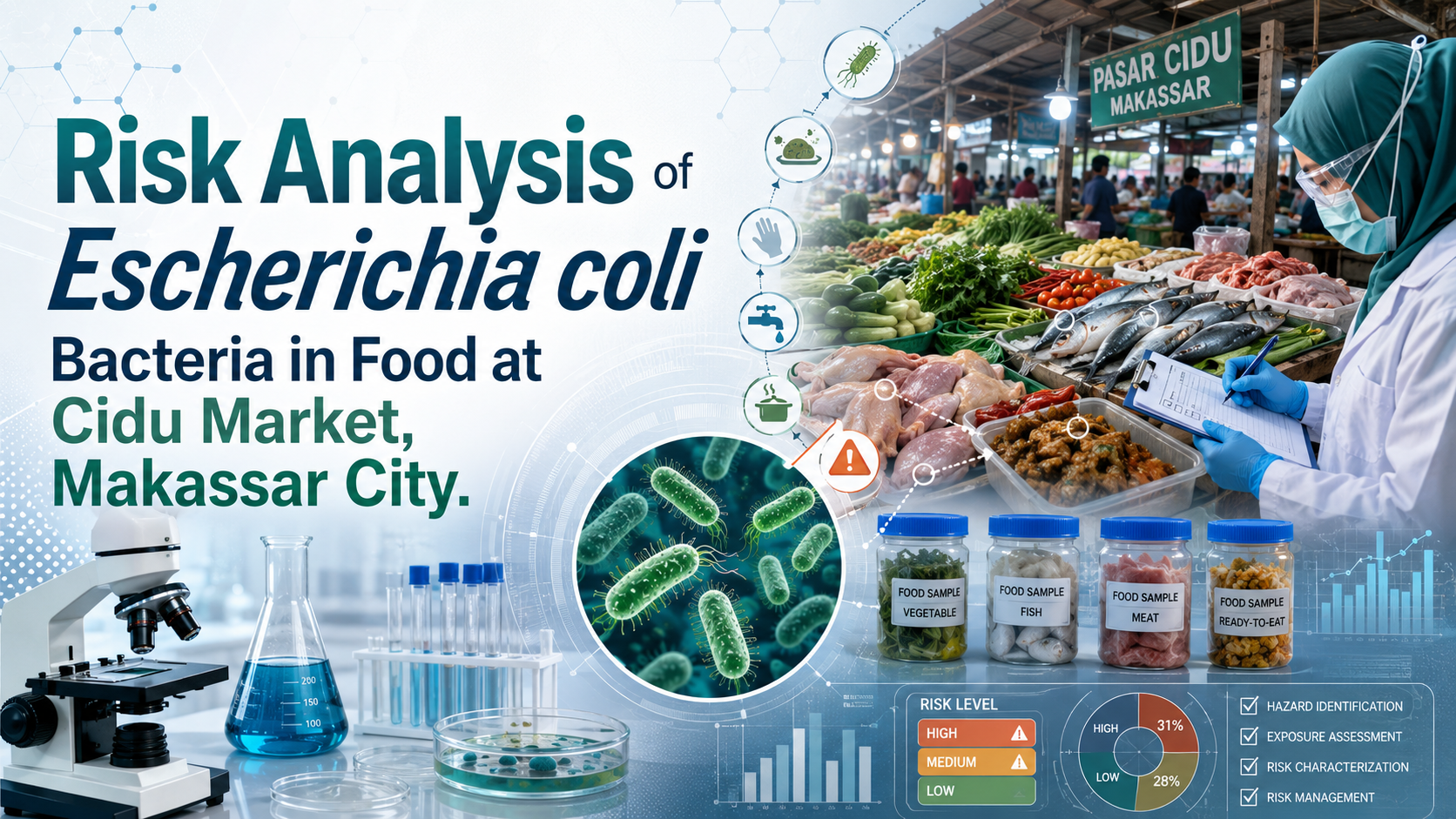
Background: Foodborne diseases remain a major public health concern, particularly in settings where food hygiene and sanitation practices are inadequate. This study aimed to assess the quantitative risk of Escherichia coli contamination in street food sold at Cidu Market, Makassar City, using the Quantitative Microbial Risk Assessment (QMRA) approach.
Methods: A cross-sectional study was conducted involving 10 food samples, 10 food handlers, and 100 consumers. Data were collected through direct observation, structured interviews, and laboratory examination of food samples using the Membrane Filter method to determine E. coli contamination levels. Risk characterization was performed following the QMRA framework.
Results: All food samples (100%) were contaminated with E. coli, with bacterial counts ranging from 2 to 25 CFU/g. Among consumers, 19% reported health complaints after consuming food from Cidu Market, with abdominal pain as the most frequently reported symptom. QMRA results indicated that the probability of infection per day (Pinf/day), annual probability of infection (Pinf.annual), and probability of illness (Pill) were predominantly classified as high risk. Poor hygiene practices were observed among food handlers, including failure to wash hands with soap (100%), use gloves (100%), wear aprons (90%), wear face masks (80%), and wear head coverings (70%).
Conclusion: The findings indicate a high risk of E. coli exposure from street food at Cidu Market. Improving food handler hygiene practices and strengthening routine food safety monitoring are essential to reduce microbial contamination and prevent foodborne diseases.
References
Alhadlaq, M. A., Aljurayyad, O. I., Almansour, A., Akeel, S. I. Al, Alzahrani, K. O., Alsalman, S. A., Yahya, R., Hindi, R. R. Al, Hakami, M. A., Alshahrani, S. D., Alhumeed, N. A., Moneea, A. M. Al, Seghayer, M. S. Al, Alharbi, A. L., Reshoodi, F. M. A. L., & Alajel, S. (2024). Overview of Pathogenic Escherichia coli, With a Focus on Shiga Toxin ‑ Producing Serotypes, Global Outbreaks (1982 – 2024) and Food Safety Criteria. Gut Pathogens, 16(57), 1–18. https://doi.org/https://doi.org/10.1186/s13099-024-00641-9
Aripin, S., Gusmayanti, E., & Fathmawati, F. (2024). Kualitas Air Sungai Pampang di Sekitar TPA Pampang Harapan Kabupaten Kayong Utara Kalimantan Barat. Sulolipu: Media Komunikasi Sivitas Akademika Dan Masyarakat, 24(1), 110–119. https://doi.org/10.32382/sulo.v24i1.298
Ayu, A. D. (2020). Quantitative Microbial Risk Assessment (QMRA) Bakteri Salmonella dan Escherichia coli pada Ayam Lalapan di Warung Makan Sekitar Kampus Universitas Hasanuddin Kota Makassar (Vol. 2507, Issue February). Universitas Hasanuddin.
Budiarso, T. Y., Prihatmo, G., Restiani, R., Pakpahan, S., & Sari, L. (2021). Detection Staphylococcus aureus Producing Enterotoxin A on the Skewers Meatballs Product in Yogyakarta City Indonesia. Journal of Physics: Conference Series, 1–7. https://doi.org/10.1088/1742-6596/1397/1/012044
Chen, Y., Lin, C. H., Huang, Y. C., & Tsai, Y. H. (2025). Quantitative Microbial Exposure Assessment of Uropathogenic Escherichia coli in Ready-to-Eat Chicken: Consumer Risk and Mitigation Strategies in Taiwan. Food Research International, 222, 117642. https://doi.org/10.1016/j.foodres.2025.117642
Damayanti, A. Y., Syafii, N. K., & Fathimah, F. (2021). The Relationship Between Food Handlers’ Knowledge and Behavior with the Presence of E. coli Bacteria in Food in Islamic Boarding Schools. Tambusai Health Journal, 2(1), 47–60. https://doi.org/10.31004/jkt.v2i1.1545
Fusaro, C., Guerrero-vargas, N., Sarria-guzmán, Y., Serrano-silva, N., Bernal, J. E., Ríos-montes, K., Eliza, H., Luna, R., Antonio, J., Ángel, D., Peredo-lovillo, A., & González-jiménez, F. E. (2025). Molecular Identification of Escherichia coli Isolated from Street Foods : Global Evidence and Public Health Implications. Microbiology Research, 16(1), 1–22.
Joshi, A., Bhardwaj, D., Kaushik, A., Juneja, V. K., Taneja, P., Thakur, S., & Taneja, N. K. (2022). Advances in Multi-Omics Based Quantitative Microbial Risk Assessment in the Dairy Sector: A Semi-Systematic Review. Food Research International, 156, 111323. https://doi.org/10.1016/j.foodres.2022.111323
Jumakil, Yanti, V., Harleli, & Fithria. (2021). Taste, Price, Hygiene and Hygiene Related to the Selection of Places to Eat Marine Juice. Jurnal Ilmiah Kesehatan Sandi Husada, 10(2), 431–439. https://doi.org/10.35816/jiskh.v10i2.609
Kasim, K. P., Juherah, Rahmadani, F. F., Rostina, & Saleh, M. (2022). Personal Hygiene Analysis on Food Serving at Panakkukang Fresh Market, Makassar City. Hygiene: Jurnal Kesehatan Lingkungan, 8(3), 171–177. https://doi.org/https://doi.org/10.24252/higiene.v8i3.35825
Magfirah, I. (2024). Analysis of the Presence and Risk Factors of Bacteria Escherichia Coli In Orange JuiceIn Takengon 2023 JUK-Medifa. Jurnal Kesehatan, Rekam Medis Dan Farmasi, 3(01), 151–155. https://doi.org/https://doi.org/10.58471/juk-medifa.v3i01.632
Mohamed, M.-Y. I., & Habib, I. (2023). Pathogenic E. coli in the Food Chain across the Arab Countries: A Descriptive Review. Foods, 12, 1–18. https://doi.org/https://doi.org/10.3390/foods12203726
Mulyati, S., Raharjo, M., & Nurjazuli, N. (2024). Factors Associated with the Presence of E.coli in Food: Literature Review. Media Publikasi Promosi Kesehatan Indonesia, 7(7), 1804–1810. https://doi.org/https://doi.org/10.56338/mppki.v7i7.5325
Nasution, A. S. (2020). Hygiene of Food Handlers Causes Contamination of Escherichia coli in Traditional Market Snacks. Promotor, 3(1), 1–6. https://doi.org/10.32832/pro.v3i1.3119
Noviana, N., & Ruhban, A. (2020). Identify the Content of Escherichia coli and Salmonella Bacteria in Burgers Sold by Street Vendors in Makassar City. Sulolipu, 19(2), 259. https://doi.org/10.32382/sulolipu.v19i2.1348
Nuralia. (2025). Risk Assessment of Bacterial Exposure from the Consumption of Student Snacks at Elementary School of Biringkanaya District, Makassar City [Hasanuddin University]. http://repository.unhas.ac.id/id/eprint/43166
Okito, A. M., Wagacha, J. M., Lukhoba, C. W., Lina, A. A., & Mukabana, W. R. (2025). Food and Water Safety Risks From Salmonella enterica and Escherichia coli Contamination in Bukavu City, Democratic Republic of the Congo Study area. Cureus, 17(3), 1–17. https://doi.org/10.7759/cureus.79951
Popkin, B. M., Corvalan, C., & Strawn, L. M. G. (2020). Dynamics of the Double Burden of Malnutrition and the Changing Nutrition Reality. The Lancet, 395, 65–74.
Romadhon, T., Rahayu, W. P., & Kusumaningrum, H. D. (2023). Dayak Onion Extract Inhibits the Growth of Escherichia coli and Staphylococcus aureus in Chicken Meat. Jurnal Ilmu Pertanian Indonesia, 28(3), 504–512. https://doi.org/10.18343/jipi.28.3.504
Saputri, D. E., & Inayah, I. (2020). The Relationship Between Hygiene, Sanitation, Meatball Processing and Bacteriological Quality in Limbung, Gowa Regency. Sulolipu: Media Komunikasi Sivitas Akademika Dan Masyarakat, 20(1), 42. https://doi.org/10.32382/sulolipu.v20i1.1472
Sari, D. Y., Pisestyani, H., & Lukman, D. W. (2020). Antibiotic Resistance in Escherichia coli Isolated from Döner Kebab Sold in Dramaga Bogor, Indonesia. Advances in Animal and Veterinary Sciences, 8(3), 278–284. https://doi.org/10.17582/journal.aavs/2020/8.3.278.284
Utami, A. P. (2021). Literature Review: Relationship of Personal Hygiene of Food Handlers with Escherichia coli Contamination in Food. Journal of Food and Culinary, 4(1), 25. https://doi.org/10.12928/jfc.v4i1.4032
Wardhana, D. K., Safitri, D. A., Annisa, S., Effendi, M. H., & Harijani, N. (2021). Detection of Escherichia coli Contamination Using Most Probable Number (MPN) Methods in Chicken Meats in Market of Surabaya. Jurnal Medik Veteriner, 4(1), 118–124. https://doi.org/10.20473/jmv.vol4.iss1.2021.118-124
WHO. (2016). Quantitative Microbial Risk Assessment: Application for Water Safety Management. World Health Organization. https://www.who.int/publications/i/item/9789241565370
Yang, S. Y., & Yoon, K. S. (2022). Quantitative Microbial Risk Assessment of Listeria monocytogenes and Enterohemorrhagic Escherichia coli in Yogurt. Foods, 11(7), 971. https://doi.org/https://doi.org/10.3390/foods11070971
Zaenab, Z., Nurhaidah, N., Chalizhah, I., & Azizah, N. (2024). Personal Hygiene Factors of Handlers and Sanitary Conditions of TPM on the Bacteriological Quality of Snack Food in Culinary Cidu Market, Makassar City. Sulolipu, 24(2), 378–391. https://doi.org/https://doi.org/10.32382/sulo.v24i2.952
Zhang, Y., Schmidt, J. W., Arthur, T. M., Wheeler, T. L., Zhang, Q., & Wang, B. (2022). A Farm-to-Fork Quantitative Microbial Exposure Assessment of β-Lactam-Resistant Escherichia coli Among U.S. Beef Consumers. Microorganisms, 10(3), 661. https://doi.org/10.3390/microorganisms10030661
Published
How to Cite
Issue
Section
Copyright (c) 2026 Haerani Haerani, Syamsuddin Syamsuddin, Inayah Inayah

This work is licensed under a Creative Commons Attribution-ShareAlike 4.0 International License.